 Weather today
Demonstrations, discord, unconstitutionality: How do Council of Europe member states react to Istanbul Convention?

Signed in Istanbul, Turkey on May 11, 2011, the Convention on preventing and combating violence against women and domestic violence, aka ″the Istanbul Convention″, has been for now ratified only by 34 out of the 47 countries represented in the Council of Europe (though all the member states have signed it).
Croatia and Greece appear to be the last countries for now to ratify the deal. Though originally aimed at combating violence against women and domestic violence, critics of this Convention in numerous CoE states firmly characterize it as a specific kind of “Trojan horse” designed to authorize “third gender” and same-sex marriages.
Armenia is among the Council of Europe member states which has not yet ratified the Convention - despite having signed it back in 2017 (the ratification phase is still in progress). Many in Armenia are opposed to the ratification, convinced that it is aimed at the protection of homosexuals to permit their marriages. A recently initiated petition has attracted numerous supporters.
The Armenian authorities insist on the contrary, i.e. – that this kind of Convention is not there to allow homosexual marriages as it only addresses women's protection. They consider the critics of those advocating the measure to be ″backward people″ or ″wife-beaters″.
Thus, Latvia, Poland, Lithuania, Liechtenstein, Hungary, United Kingdom, Moldova, Czech Republic, Ukraine and Armenia are among the Council of Europe member states which have signed – but not yet ratified – the Convention. Bulgaria has declared it totally unconstitutional, with Russia and Azerbaijan not having signed and ratified it at all ...
Istanbul Convention sparked multi-thousand demonstrations in Croatia
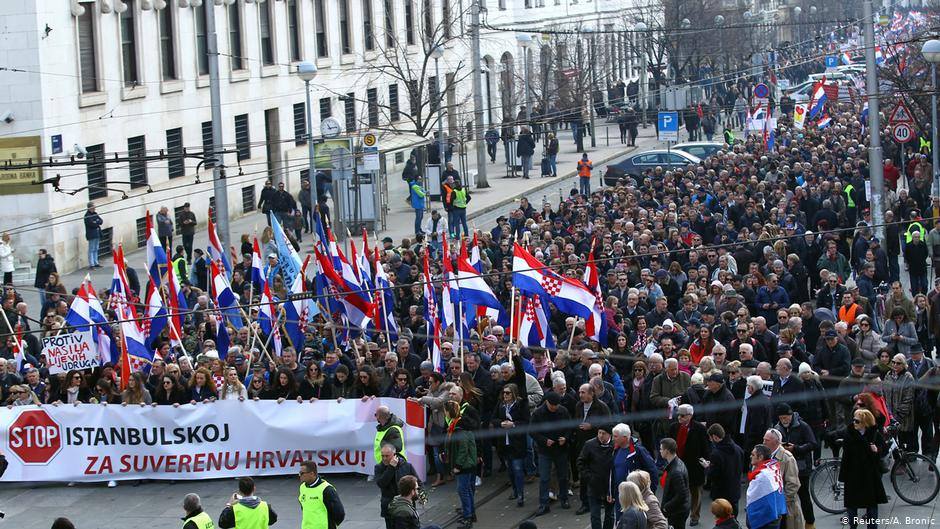
Greece and Croatia, which only recently ratified the Istanbul Convention, cannot be said to have smoothly proceeded to the process as thousands of citizens took to the streets in [Croatia's] capital Zagreb to protest against the ratification. The protesters voiced opposition against the ″third gender″ and same-sex marriages, which is to say, the Convention was practically ratified by the Croatian authorities despite the raging discontent and multi-thousand protests.
Ukraine has not ratified the Convention
Interestingly enough, Ukraine has not ratified the Convention. Though the former president, Petro Poroshenko, insisted on a ratification, the Convention won't receive an unequivocal acceptance in the country. To rule out violence against women and domestic violence, Ukraine has domestically adopted several laws, among them being, for example, law №5294, ″On Preventing Violence against Women and Domestic Violence″. Its text excludes such terms as ″gender″, ″gender identity″, ″feelings about gender″ and ″sexual orientation″.

In Ukraine, the national church expressed its opposition to the law on the grounds that this kind of Convention calls for the incorporation of ‟gender‟, ″gender identity″, ″feeling about gender″, ″sexual orientation″ and other notions into the domestic laws. The argument was that it is beyond the scope of what is termed as “sex″ in the generally adopted practice and misrepresents, in point of fact, the perception of the equality of the rights of women and men, as well as the gender policies pursued on a nationwide level.
Latvia: The government has postponed the ratification
Here too, the population has opposed to the ratification of the Istanbul Convention. ‟Those who are trying to push ahead with the ratifying the Convention are humiliating Latvia. We are a modern European state where the equality of genders is totally a subject,″ a member of the Latvian parliament, Yulia Stepanenko, stated.
Among the governing political forces in Latvia, Unity for now appears to be the only party backing the Convention.
Bulgaria has declared the Convention anti-constitutional
In a speech before the parliament, Prime Minister Boyko Borisov said that the issue attracted a sharp reaction by the Bulgarian Ortodox Church and the Chief Mufti, provoking a general feeling of fear among the Bulgarian people.
In a decision passed on July 27, 2018, the Bulgarian Constitutional Court said the ″Council of Europe Convention on preventing and combating violence against women and domestic violence is not in line with the Constitution of the Republic of Bulgaria″. The court cites in its ruling a connection to earlier Council of Europe documents on domestic violence and the spread of transgender people’s rights.
United Kingdom has not ratifed the Convention either; more serious affair to accomplish
The United Kingdom, which signed the Convention in 2012, cites the national Constitution as an excuse behind its non-ratification, the underlying assumption being the fact that it needs to incorporate amendments into the Constitution to have the power to ratify this instrument. The move is thought to entail large-scale costs (due to the financial crisis) potentially, not being treated at all as a primary issue (″amid the more important affairs to accomplish″).
Slovakia has also rejected the ratification
Slovakia has also rejected the Convention on the grounds of the third gender clause; it has thus declared the instrument illegitimate.
---
The Istanbul Convention turns out in fact not to have met an unequivocal acceptance even by the European countries traditionally having the reputation of "developed states". It has met a sharp criticism by a number of public, political and religious circles across the Council of Europe, including even the countries which have signed and ratified it. Many countries, such as the United Kingdom and Bulgaria, said it is contrary to their Constitution, whereas lots of others have claimed that violence in family and against women is regulated under their domestic legislation. The entire criticism is around the term ″gender″, which is not clearly worded in the Convention, thereby giving ground to the assumption that the Convention is, in point of fact, called to ratify same-sex marriages.






 Studio One