 Weather today
Armenia’s accession to Eurasian Economic Union equation with several unknown quantities – Styopa Safaryan

Political scientist Styopa Safaryan has strong doubts that a treaty on Armenia’s accession to the Eurasian Economic Union (EAU) will be signed on October 10.
According to him, Russia has on many occasions left the issue of Armenia unsettled because it has to exert pressure on Armenia to prevent it from conducting further negotiations with Brussels on the scale that would be of benefit to Armenia.
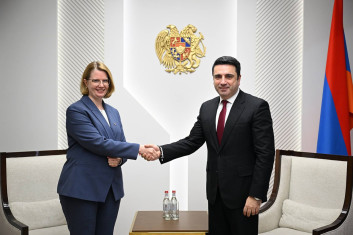
Mr Safaryan, the German ambassador to Armenia stated recently that, depending on what is going to happen at the meeting of the CIS Council of Heads of State in Minsk, when Armenia will have probably joined the Eurasian Economic Union, the guidelines for further Armenia-EU cooperation.
On one occasion, I said that the delay in Armenia’s accession to the Eurasian Economic Union had a far-reaching aim as well – keeping Armenia from developing relations with Europe. I would like to remind you that on September 5, 2013, the European Commission put out a release, which considered Armenia’s wish to join the Customs Union and stressed they expected official Yerevan to specify the scope of its commitments to the Eurasian Economic Union, to form a clear idea of the scale of Armenia-EU negotiations over a new agreement. Since September 3, 2013, Brussels has made numerous attempts to remind official Yerevan of its duty to provide clarifications. Secondly, the Nalbandian-Ashton statement in Vilnius identified the areas of cooperation, but the specific features of the Eurasian Economic Union and Armenia’s relevant commitments necessitated clarifications. Now that the fundamental treaty on the Eurasian Economic Union has been signed and is to be enforced next January, some clarifications will be made. In any case, there is lack of information on Armenia’s membership and no one can understand the degree of Armenia’s involvement in the Eurasian Economic Union, considering the specific features that prevented Brussels from undertaking initiatives in relations with Armenia. Moscow is well aware of that and has often left the issue of Armenia unsettled because it has to exert pressure on Armenia to prevent it from conducting further negotiations with Brussels on the scale that would be of benefit to Armenia. The problem has been left unsettled, and Brussels and Yerevan cannot maintain contacts. And Moscow has not been much interested in that because, in contrast to Ukraine, when it had to make a forceful intervention, sustaining losses in terms of both economy and reputation, it does not pay the cost in the case of Armenia.
Therefore, this is one more reason for doubts about the success of such a treaty and Moscow’s interest in achieving the aim. I think the issue remains a topical one. Therefore, as long as Armenia’s commitments remain uncertain, Armenia-EU relations will remain uncertain as well. So the meeting scheduled for October 10 will answer numerous questions, and the German ambassador is right, and we will either see some things clarified or understand further developments.
Do you see any possibility of Armenia joining the Customs Union rather than the Eurasian Economic Union?
The problem is that the past year has seen numerous options, with each of them discussed: Armenia as a founding member, Armenia as a member with a special status – that is, numerous statements have been made. Vladimir Putin promised Armenia’s accession to the fundamental agreement on March 5, which never happened. And the possibility you have mentioned could be one of the numerous options. So it is most difficult to forecast what’s going to happen on October 10.





 Studio One