 Weather today
Armenia’s EEU membership justified in context of regional cooperation

In an interview with Tert.am, economist Tatul Manaseryan spoke of the results of the decision in favor of Armenia’s accession to the Customs Union on September 3, 2013, expectations, as well as of Russian President Vladmir Putin’s proposal to reject the US Dollar and Euro.
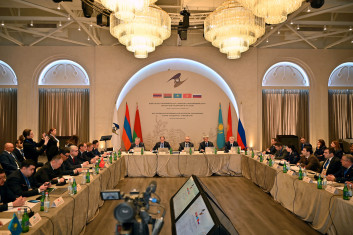
Russian media report that Vladmir Putin has introduced a bill before the Russian State Duma, proposing rejection of the US dollar and euro in the Commonwealth of Independent States (CIS). The bill envisages a common market between the Eurasian Economic Union (EEU) member-states and the other CIS members and a mechanism that would enable the states to reject the US Dollar and Euro as the interim currency in their transactions.
As to whether Armenia could benefit from or, on the contrary, affected by, it in the context of proposals by a number of economists that Armenia should not pay for Russian gas in USD terms, Mr Manaseryan said:
“If we speak of gas, it is in Armenia’s interests to pay in Russian roubles because we will thus pay less. And if we speak of a strategic ally, it is absolutely right. Economic unions generally prefer a common currency. For example, you can never see Euros – an international currency - used in the United States. Nor does Europe use the US Dollar. It means that each zone is promoting its own currency.”
“As regards the creation of such a mechanism in the CIS, it is a rather long process. We can speak of the commencement of this process, but not of its duration. And we cannot claim we can do this or that within a particular period. I would like to remind you of a precedent years ago, when the Russian leader signed a decree on convertible rouble. However, a currency never becomes convertible by administrative means in any present-day market economy. If they intend to introduce a common currency, it implies harmonized monetary, currency and off-budget policies. All this implies certain restrictions. For example, margins of exchange fluctuations in individual countries. And if we consider the fact ha the EU took about half a century to introduce a common currency, we can imagine the efforts made.”
As to the reasons for the Russia president’s statement, Mr Manaseryan said that the statement inaugurates the process because all economic unions follow such principles.
“It we consider the Eurasian Economic Union, this is the highest form the founding states are seeking. Therefore, in case of integration they have to have a common currency. After all, it is money that serves economy rather than vice versa.”
Asked whether the issue of Armenia paying for Russian gas in Russian roubles is a matter of negotiations, Mr Manaseryan said that it is an important component of economic diplomacy, and hardly anyone has a an idea of it in Armenia.
On September 3, 2013, Armenian president Serzh Sargsyan announced Armenia’s accession to the EEU, and Armenia has been an EEU member for nine months. Asked about Armenia’s benefits from EEU membership, Mr Msanaseryan said:
“If anyone answers your question, he is a dabbler. After years, the European Union member-states are only now thinking of benefits of being together. And now they want to expel certain states. That is, it is short-sightedness to make any assessments after several months. In this context, I think it is important that, when a union is formed, a regional country be isolated and prove successful in filling its niche in global economy. I rule it out. All examples prove it. So whether we like it or not we have to put up with regional integration. Since Turkey and Azerbaijan are regional states as well, our chances are not so high. In this sense, it would be a short-sighted policy to refuse to join the union.”






 Studio One