 Weather today
Bizarre trend sees Chinese beach-goers using green algae

As thick waves of green algae blanket the coastline of a resort city in China turning sea water from crystal clear to murky green, local beach-goers have found a new way to enjoy summer fun.
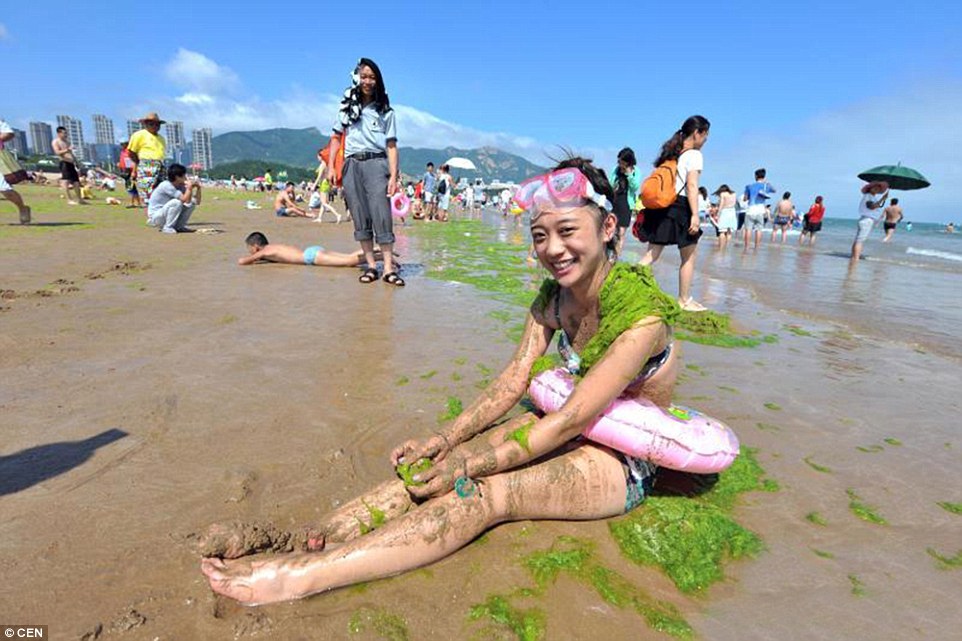
Pictures from the Chinese media show swimmers on the Shilaoren beach in Qingdao putting clamps of bright green algae on their body in a bizarre attempt to block the sun, the Daily Mail reports, citing China's state media Xinhua News Agency.
Chinese beach-goers typically go to great lengths to prevent themselves from getting tanned as white skin is considered a sign of beauty in the country. Swimmers in Qingdao also like donning a face mask known as 'face-kini' while swimming under the sun to protect their skin.
The coastline of Shandong in eastern China is currently invaded by thick waves of algae bloom.
Large scale of Ulva Prolifera infestation has been turning the once golden beaches in popular resort cities, such as Qingdao and Yantai, into verdant meadows every summer since the first outbreak in 2008.
According to Chinese media, around 11,600 hectare of ocean off the coast of Qingdao city has been covered with algal bloom since the beginning of summer, and a whopping 9,260 tonnes of the emerald green plant have been collected from the sea water in nearby Yantai city.
Alarming pictures show the coast of Qingdao and Yantai besieged by a striking amount of algae as the plant completely covering the surface of part of the ocean near the two cities.
The regions' beaches have been turned into muddy green as algae got washed up on the shores by 'green tides'.
However, the annual algae attack doesn't seem to interrupt the cities' residents from enjoying the summer.
Locals in Qingdao and Yantai were seen taking strolls on the dirty beaches, swimming in murky sea water and sitting on the sand to enjoy the unusual green coastal views.
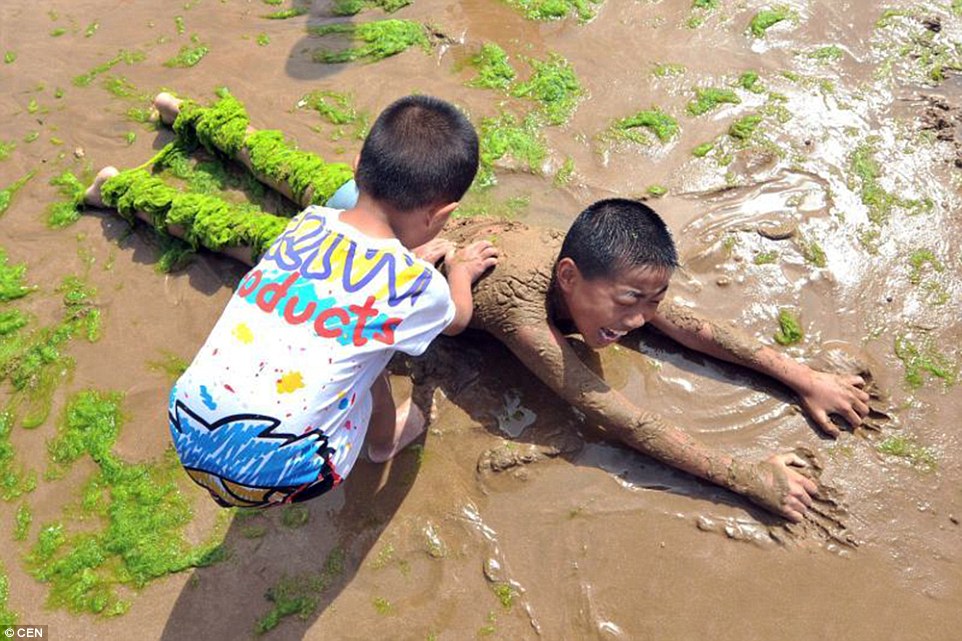
Children frolicked in the mud as they tried to cover each other with algae while young female swimmers pose for pictures with lumps of the seaweed on their backs.
According to Chinese media, the locals use the plant as an alternative sunblock to stopthem from getting tanned.
Sanitation workers were also seen removing the endless seaweed, known as Ulva Prolifera or Hutai in Chinese, using forklift trucks.
While the algae appears harmless to humans, marine life is at risk of asphyxiation as the green sludge sucks up oxygen from the water.
Many theories blame the phenomenon on climate change and industrial pollution both of which contribute to warm sea temperatures that help cultivate the algae's rapid growth.
But as the tourist cities struggle with yet another year of the bloom, scientists have blamed the expansion of edible seaweed farming along the coast as an alternative explanation to the outbreak.
A study from 2013 the journal Estuarine, Coastal and Shelf Science, concluded the algae originates from the Jiangsu coast, which is situated to the south of Shandong Province, before being swept north towards Qingdao.
Scientists from the Yantai Institute of Coastal Zone Research cited satellite images and field observations as the basis for the theory.
They believe the algae grow on the rafts used by the Jiangsu seaweed farmers and when the seaweed is harvested the Ulva Prolifera is removed from the rafts and
discarded to be swept away by the waves in the sea.
Pang Shaojun, a researcher from the Institute of Oceanology at the Chinese Academy of Science, has told China National Radio that the algal bloom in Qingdao Province came from the regions of Sheyang, Yancheng and Rudong in Jiangsu Province.
Pang, an expert on the environmental phenomenon, said that these area's seawater contains high levels of ammonia and nitrogen, and this is an important cause of the outbreak.
The algae first hit in 2008, weeks before Qingdao was in the international spotlight as the host of the sailing events for the Beijing Olympics and again in 2013 covering more than 75,000 hectares, double the amount in 2008.
More than 10,000 volunteers and 1,000 soldiers cleared the 20,000 tonnes of slime out of the sea three years ago which was then taken to a processing depot where it was dried and turned into animal feed, fertiliser and a medicinal supplement known as hutai sugar, thought to lower blood sugar.










 Studio One