 Weather today
The Diana Apcar Statue: Three Announced Dates, No Unveiling (photos)

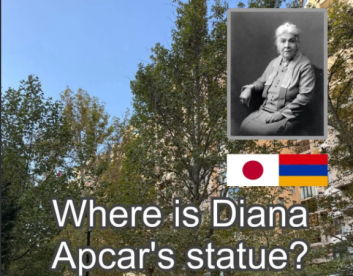
The park bearing Diana Apcar’s name on Mashtots Avenue in Yerevan has become one of the city’s best-loved places. Yet the question of installing a statue of Diana Apcar — businesswoman, philanthropist and, in the early 20th century, honorary consul of the Republic of Armenia in Japan — keeps resurfacing and has so far not been resolved.
A statue commemorating Diana Apcar is planned for installation in Yerevan, in the park that bears her name. A public fundraising campaign has been organized for the project. According to announcements published by the organizers at various times, the statue’s unveiling in 2026 was planned first for March 8, then for April 7, and later October 17 — Diana Apcar’s birthday — was announced as the opening date.
As of the date of publication, we note that no unveiling took place on March 8, on April 7, or on October 17. Moreover, the official information available to us raises questions about how well-founded these dates were, and a number of questions concerning the project’s progress, financing and approval remain without full clarification as of the time of writing.
As of the date of publication, October 19, we were unable to find any announcement on the website of the Diana Apcar Foundation (hereinafter, the Foundation) addressed to donors regarding the postponements, their reasons, or the details of an October 17 ceremony. Notably, an article published in the Armenian Mirror-Spectator on October 15, which also refers to a book co-authored by Meline Mesropyan, states with regard to a monument dedicated to Diana Apcar that “plans are underway.”
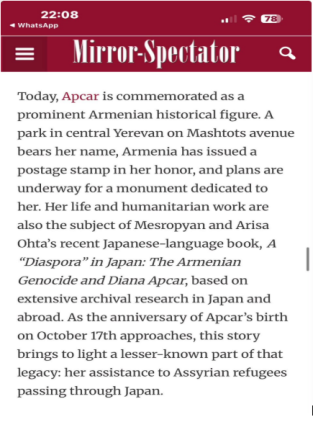
Excerpt from the Armenian Mirror-Spectator article of October 15, 2026: “plans are underway for a monument dedicated to her.”
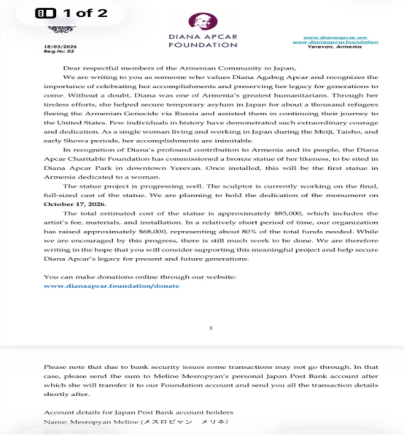
The organizers’ letter of March 18, 2026, to the Armenian community in Japan, announcing the dedication of the monument on October 17, 2026, and naming Meline Mesropyan’s personal Japan Post Bank account as an alternative way to donate.
Meanwhile, according to official information provided by the Yerevan Municipality, the application concerning the installation of the statue was registered with the Municipality on April 2, 2026 — two weeks after that letter. In other words, as of March 8, when the first unveiling was scheduled, the installation application had not yet been submitted to the Municipality, and April 7 was only five days after the application was registered. An official response received from the Yerevan Municipality in August 2026 stated that the matter was still under consideration. At present, we are not aware of any public information about a decision granting permission for the installation.
Given this chronology, a question arises: what stage was the project at when specific opening dates were being announced? At the time donors were being told about the October 17 date, the installation application, according to the Municipality’s response, had not yet been registered. In the author’s assessment, announcing one specific date after another while the question of installation permission was still unresolved may have given donors the impression that the project was at a more advanced stage than the official documents indicate.
The March 18 letter stated that about USD 68,000 of the required USD 85,000 had been raised. That statement alone, however, does not make clear whether the entire amount had actually been received or whether it also included pledged donations. The distinction matters, because the decision to donate is often made with an eye to how close a project is to completion.
The letter also offered an alternative way of transferring money. If online payment was not possible, donors were invited to transfer funds to the personal Japan Post Bank account of Meline Mesropyan, one of the Foundation’s founders, after which, according to the letter, the money was to be transferred to the Foundation’s account. In this respect, too, those who donated to the personal account have not received any proof that their donation reached the Foundation for its intended purpose.
Collecting donations through an individual’s personal account does not in itself mean that funds have been misused, and the author makes no such claim. However, this method reduces transparency: the movement of funds in a personal account is, as a rule, not subject to the accountability requirements that apply to a legal entity, and donors lose the ability to follow what happens to their money.
From the published information it is not possible to determine how much money was actually transferred to that account, how much was passed on to the Foundation, or how the transactions were recorded. As of the time of writing, we were unable to find on the Foundation’s website any public financial report on the fundraising campaign or on the Foundation’s activities.
It is therefore important for the project organizers to present a summary report on the fundraising, indicating the amount of donations received (separately showing the amounts received through the personal account and those transferred to the Foundation), the expenses incurred, the remaining balance, and the intended future use of the funds. Given the amount indicated in the letter and raised by the Foundation, the Foundation is subject to the requirements of a mandatory audit and annual publication of its reports. We also consider it necessary to note that the state body responsible for oversight in this area is the State Revenue Committee.
It is also important to clarify what will happen to the funds raised if permission to install the statue is not granted or the timeline is significantly extended, and whether donors may request a refund.
Raising these questions is not a conclusion that any violation has occurred, and it contains no accusation against any person or organization. The point is the importance of access to financial information in a public fundraising campaign and of donors being properly informed.
The project’s official website states that at the initial stage of the initiative the “National Center” Development Foundation received the approval of the Yerevan Municipality. However, the website does not publish the details (date, number, issuing body) of any document confirming that approval.
At the same time, according to the Municipality’s response, the application concerning the installation of the statue was registered on April 2, 2026, and in August the matter was still under consideration.
It is possible that the earlier approval concerned the idea of the project or a preliminary discussion, while the 2026 application concerned the specific terms of the statue’s installation. To clarify this, it is necessary to know which document was meant in the statement about the Municipality’s approval, what stage the installation permit process had reached, and what entitled the organizers to display in their announcements official logos — including, but not limited to, that of the Yerevan Municipality. (The logos of the Embassy of Japan, the Academy of Fine Arts and other organizations were also displayed; these organizations have denied being aware of, involved in and/or supporting the project.)
In the author’s opinion, if “approval” referred only to a preliminary acceptance of the idea, and there was not yet any installation permit, explaining this difference clearly to donors would have reduced the risk of misunderstanding.
Background: the project is not new. The initiative to install the statue began well before the 2026 fundraising campaign and the announcements of planned opening dates.
According to the project’s official website, in October 2022 the “National Center” Development Foundation launched work on creating the statue. A design competition was held in 2024, and participants were informed of the selected work on May 28. According to the same website, the selected model was sent to the Yerevan Municipality.
This information shows that the idea of installing the statue was developed over several years. However, holding a competition and selecting a model are not in themselves enough to understand what stage the installation process was at and what conditions still had to be met for it to proceed. It is also noteworthy that, according to the Municipality’s response, the installation application was registered only in April 2026 — almost two years after the model was selected — even though, when the competition results were announced, it was stated that the model had been sent to the Yerevan Municipality.
It is particularly important to clarify what the Municipality approval mentioned on the official website referred to, and how it related to the application submitted in 2026.
For months during the fundraising campaign, the Foundation’s website also presented the Embassy of Japan in Armenia as a supporter of the project, displaying its emblem (logo). This reference has since been removed, though not from every publication: as of now, the logo has not been removed from one of them.
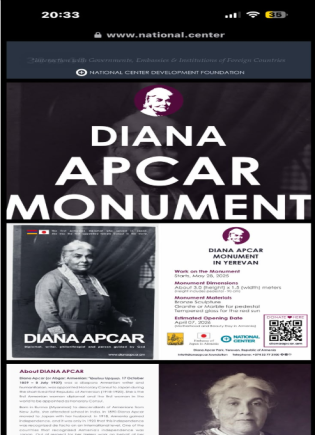
Promotional material for the monument (national.center), giving April 7, 2026 as the estimated opening date and displaying the emblem of the Embassy of Japan in Armenia.
In response to an inquiry on the matter, the Embassy stated in an official letter that it had not provided any such support and, moreover, had not granted any permission to use its official emblem in publications. The name and emblem of a foreign state’s diplomatic mission among a project’s supporters can significantly affect donors’ trust and their decisions.
Here, too, it is necessary to clarify on what basis the Embassy and its emblem were listed among the project’s supporters, why the reference was later removed, and whether donors who had transferred money while it was still displayed were informed of this. Comments from the organizers and the publication of the relevant documents could clarify this matter.
The author considers it necessary to emphasize that the project to commemorate Diana Apcar with a statue is an initiative of cultural significance. For that reason, it is important for the public and for donors to understand not only its purpose but also how it is being carried out.
At present, several questions require clarification:
– on what basis the Municipality’s approval was announced;
– on what basis the opening dates of March 8, April 7 and October 17 were successively announced while installation permission had not yet been granted;
– why donors were not informed of the postponements and their reasons;
– whether the failure to keep the October 17 date had been agreed in advance and, if not, what new timeline is envisaged;
– how the funds received during the fundraising campaign have been recorded, including those received through the personal account, and what will happen to those funds if permission is not granted;
– where the Foundation actually operates;
– on what basis the support of the Embassy of Japan and of the other organizations whose official emblems appeared in the announcements was cited.
These circumstances do not in themselves prove any wrongdoing, and the author does not claim that the organizers will fail to fulfil their commitments. If the statue is installed and a financial report is published, that will only be welcome. However, in the author’s opinion, taken together these circumstances do not inspire confidence and give serious cause for caution to anyone intending to donate. Clarifying them requires answers from the project organizers and the relevant documents. The issue is not the size of any individual donation, but the systematic and recurring fundraising campaigns conducted for a specific purpose — a purpose that remains unfulfilled.
What donors can do
Until answers to the questions above are published, the author advises taking part in this or similar fundraising campaigns only after taking the following precautions:
– before donating, request written information from the organizers on the funds already raised and spent;
– transfer money only to the official bank account of a legal entity — the foundation — and avoid transfers to individuals’ personal accounts;
– verify that the permits required to carry out the project have actually been granted, and that the organizations listed as supporters actually support the project;
– check the organization’s registration details and address in the State Register of Legal Entities of Armenia (e-register.am);
– keep all documents confirming the transfer.
Those who have already donated have the right to request written information from the organizers on the receipt and use of the money they transferred.
Complete information on the financial reporting, the approval process and the timeline would allow the public to understand what work has been done, what stage the project is at, and what steps are needed to carry it forward.
The author is prepared to publish in full the responses of the “National Center” Development Foundation and the project organizers, together with any documents they provide.
Sources and the author’s position
The factual information in this article is based on the following sources: the project’s official website; the organizers’ letter of March 18, 2026; the official response of the Yerevan Municipality of August 2026; the official letter of the Embassy of Japan in Armenia; correspondence from donors; and the Armenian Mirror-Spectator article of October 15, 2026 (“Finding Mrs. Apcar: An Assyrian Family’s Journey Through Japan”). The assessments and questions expressed in this article are the author’s personal opinion on a matter of public interest and cannot be regarded as a claim that any person has committed an offence.


 Studio One