 Weather today
Musa Dagh general theme in Prague Genocide studies conference

“Mountains of Moses: Revolt, Resistance and Rescuing of the Victims of Mass Extermination in the 20th Century” was the theme of the 1st International Conference on Genocide Studies in the Czech Republic, held in the capital of Prague from June 18 to 20.
The theme drew inspiration from the Musa Dagh resistance to the Armenian Genocide in 1915, a saga that was immortalized by Franz Werfel in the novel, The Forty Days of Musa Dagh.
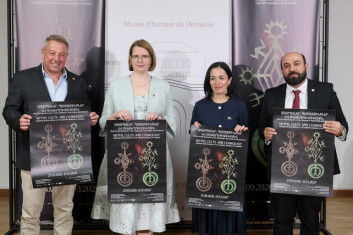
The conference was organized by the Archaeology of Evil Research Centre (AERC) as part of the NINE GATES Festival that annually promotes Jewish culture in the Czech Republic and elsewhere in Europe. This year’s festival, including the conference, enjoyed the patronage of the President of the Czech Parliament, the Prime Minister, a number of ministries, and the embassies of China, Spain, and Sweden.
The mission of the AERC is “to reflect causality and motives of historical genocides and mass violence on the basis of comparative interdisciplinary research, to gather specific primary and secondary data on genocides and mass murders during the world history, and explore new ways of dissemination of research results. Long-term objective of the Centre is to introduce and establish the Genocide Studies discipline in the Czech Republic.”
The objectives of the conference were: to introduce the scope and method of Genocide Studies in the Czech Republic; to analyze historical events of revolt, resistance and rescue of the victims of mass extermination/genocides in the 20th century with regard to the relevant historical context; to compare selected historical events on the basis of common aspects.
The opening ceremony took place on June 18 at the Viola Theater. Pavel Zuna, a well-known Czech TV personality, introduced the conference participants and invited Tigran S. Seiranian, Ambassador Extraordinary and Plenipotentiary of the Republic of Armenia to the Czech Republic, to deliver the inaugural address. In his statement, the Ambassador made reference to Werfel as a native son of Prague, informing the audience that on April 24 of each year the Armenian community in Prague places wreaths at the houses where the author was born and had lived. Seiranian also indicated that the Turkish Government continues to deny the Armenian Genocide, thereby continuing the process of genocide. A representative group of Armenians including the Very Reverend Barsegh Pilavjyan, spiritual head of the Armenians in the Czech Republic, Slovakia, and Hungary, Hakob Asatryan, chief editor of the local Orer (Days) Armenian periodical, artists, and professionals were also present.
The Ambassador’s speech was followed by an impressive thematic performance of Czech poet Pavel Zajchek, titled “Lives? Or Vicious Circles?” with the accompaniment of the underground DG 307 band. The evening concluded with a reception.
On the following day, June 19, the conference began at the Protestant Theological Faculty of Charles University with a keynote lecture by Dr. Paul A. Levine, Associate Professor and Docent of Holocaust History at the Hugo Valentin Centre, Uppsala University, Sweden. Titled “Genocide Studies Today: An Overview and Analysis,” the lecture briefly explored “the ‘histories’ of the two fields [of Holocaust and Genocide], their conflicts and areas of growing comity, and what the future might hold for these two dynamic and multi-disciplinary scholarly fields, both of which have high and still growing social relevance.”
Next, in order to provide the audience—consisting mainly of professors, university students, diplomats, and other interested persons—with a general background about the Armenian extermination and dispossession, Andrew Goldberg’s hour-long documentary, titled “The Armenian Genocide” (2006), was shown on a large screen.
“Mountains of Moses” was a serious and successful event, one that added to the growing number of international conferences on the subject of genocide. The organizers plan to publish the proceedings and to hold similar symposia annually, with different themes.


 Studio One